By: Kirby G Mack (Vice President of Digital Media at Simplicity Lone Beacon)
As of 2025, AI tools like ChatGPT are increasingly used for general searches, and the trend is accelerating rapidly.
AI-powered results are now default on most mobile searches in the U.S., meaning AI-generated answers are the first thing many users see.
People are leaning on ChatGPT’s for:
- Quick facts
- How-to queries
- Product/service comparisons
- Research summaries
Navigating New AI Overviews: What Financial Advisors Need to Know
With the introduction of AI Overviews, Google is transforming the way search results are presented and SEO must adapt. Powered by the Gemini AI model, these overviews appear prominently at the top of search engine results pages (SERPs), delivering quick, comprehensive summaries in response to complex user queries. While the goal is to enhance the user experience by providing immediate, helpful information, this shift introduces new considerations for content visibility and optimization. Unfortunately this new search trend will inherently hurt your websites organic traffic.
AI Overviews can decrease click thru, with some studies showing a drop of up to 64% depending on the search and the industry.
What Are AI Overviews?
AI Overviews synthesize information from various web pages to generate concise, AI-powered summaries. These summaries appear above traditional organic results and often include links to the original sources, offering a potential boost in traffic to those sites. Early data suggests users are more likely to click on links within these AI-generated sections than on standard search listings making it more important than ever for website content to be accurate, well-structured, and optimized for relevance.
How to Prepare for AI Overviews
As Google’s AI Overviews continue to reshape search results, SEO professionals and Financial Advisors must proactively adapt.
To help your financial advisor website rank or be featured in Google’s AI Overviews, you need to combine traditional SEO best practices with newer strategies aimed at increasing visibility in generative AI summaries. Here are 7 actionable tactics you can use:
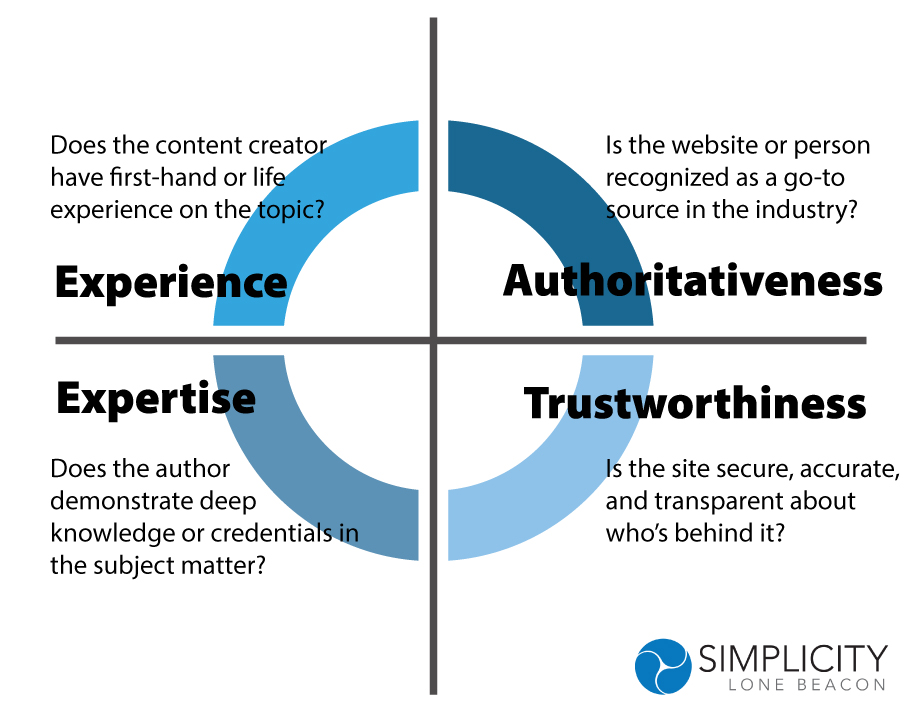
1. Prioritize The “E-E-A-T” Experience
Google’s E-E-A-T framework (Experience, Expertise, Authoritativeness, Trustworthiness) they are now prioritizing firsthand experience, not just expertise.
- Include personal stories, examples, or client experiences.
- Include detailed author bios for advisors and content contributors, listing credentials (CFP, CPA, etc.), experience, and affiliations. This is how Google acknowledges your legitimacy.
- Link to case studies, testimonials, or behind-the-scenes processes. Linking to case studies and testimonials is important because it builds credibility and trust. Google’s algorithms — including AI Overviews — prioritize content from credible, real-world sources. Linking to client success stories proves real experience and results. Anyone can say they help clients build wealth — but linking to a testimonial or case study makes it tangible.
2. Build Topical Authority
- Create a hub-and-spoke content structure: One authoritative page (e.g., “Comprehensive Guide to Retirement Planning”) surrounded by related blog posts (e.g., “Roth IRA vs. Traditional IRA”, “How to Maximize Social Security”).
- Publish in-depth, expert-level content regularly on topics like financial planning, taxes, estate planning, and retirement strategies.
- Cite credible sources and link to high-quality external references to boost trust.
3. Answer Complex User Queries Clearly
- Google’s AI Overviews favor content that answers multi-layered questions (e.g., “How can a fiduciary advisor help me minimize taxes in retirement?”).
- Use natural language, structured headings (h2, h3, etc.), and concise paragraphs to clearly answer these queries.
- Incorporate FAQ sections, summaries, and direct answers using “What,” “How,” “Should I…” style questions.
4. Add Structured Data & Schema Markup
Implement schema types like:
- Person or Organization for your advisor or firm
- FAQ Page for your FAQ sections
- Article for blog posts
5. Ensure Fast, Accessible, Mobile-Friendly Design
Ensure your site:
- Loads in under 3 seconds
- Is mobile-optimized
- Complies with ADA accessibility (important for compliance and reach)
- Use tools like Google Lighthouse, PageSpeed Insights, and AccessiBe.
6. Monitor Google Search Console + AI Mentions
Keep tabs on:
- Changes in impressions and clicks
- Emerging search queries
- Pages gaining traction
- Watch for AI-related traffic surges, even if not labeled as such (yet).
7. Use Conversational & User-Focused Content
Write in a tone and format similar to what someone might ask Google Assistant or ChatGPT:
- “What’s the best age to start drawing Social Security?”
- “How much should I save for retirement in my 50s?”
- “What Does a Fiduciary Financial Advisor Actually Do?”
Google dominates with a massive user base. Google.com had 139.9 billion visits in January 2025. Google Search processed 14 billion searches per day in 2024.
ChatGPT has a substantial user base, but significantly smaller than Google’s. It had 400 million weekly active users worldwide as of February 2025. ChatGPT.com recorded 5.2 billion visits per month in March 2025.
ChatGPT is not currently replacing Google Search on a large scale. But AI tools are impacting search behavior, and they are interwinding.
Financial Advisors MUST adapt, you need to change your strategies to be visible in both traditional search results and AI-driven platforms
Remember “Being first gets attention. Staying ahead earns trust.“